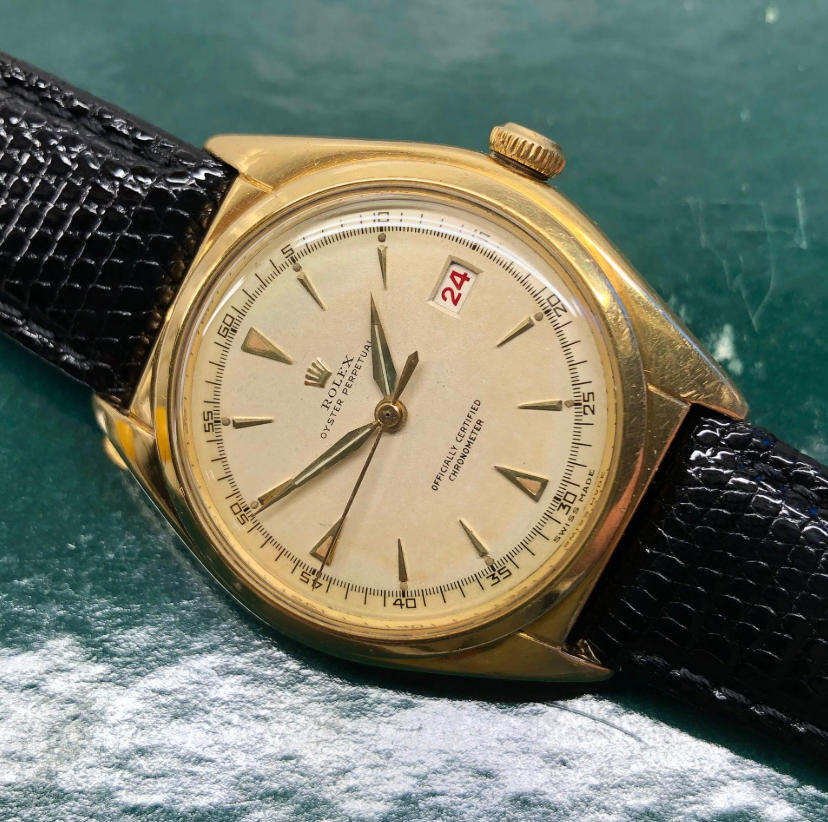
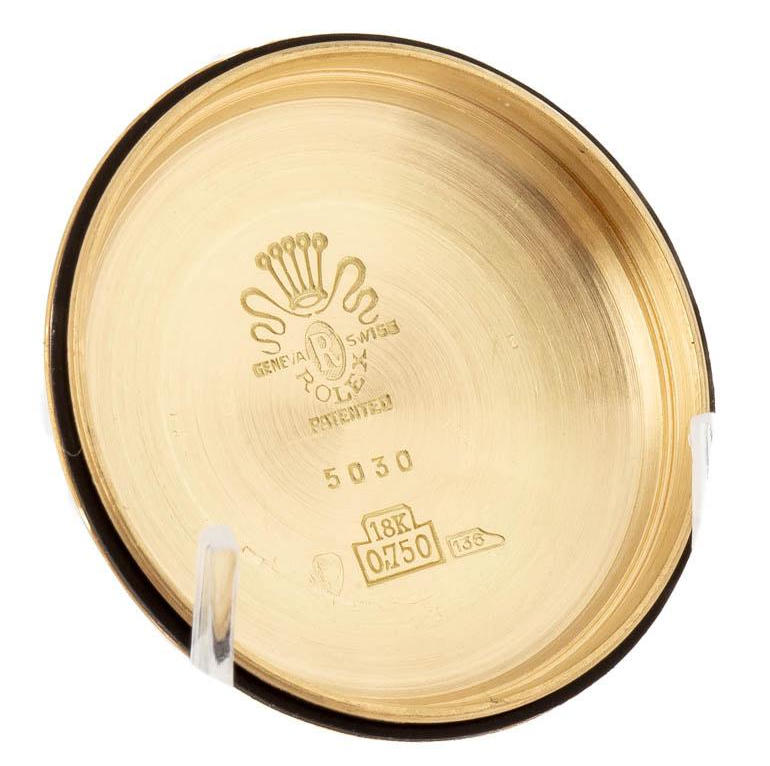
It is difficult to look at a modern Rolex Datejust without already knowing what to expect. The date belongs at three o’clock, the Cyclops sits above it, the case feels neat and relatively flat, and the choice between an Oyster or Jubilee bracelet has become part of the familiar Datejust formula.The Rolex Oyster Perpetual ref. 5030 comes from a period when that formula was still being worked out.
Produced around the end of the 1940s, the ref. 5030 sits only a few years after Rolex introduced the Datejust in 1945. It already contains several ideas that would become central to the collection, most importantly the automatic Oyster construction and the date window at three. Yet it also lacks some of the details that later generations made almost inseparable from the Datejust name.
There is no Cyclops magnifier. The case has a noticeably deeper and more rounded profile. The dial does not necessarily carry the Datejust name in the way later references do. Even the relationship between the case, bezel and bracelet feels different from what a reader familiar only with modern Datejust watches might expect.That is precisely why this reference deserves more than a short vintage-watch description. For readers of Rolex Datejust replica watches, the ref. 5030 also makes an unusually useful comparison point. It shows that recreating an early Datejust means understanding how the watch was constructed in its own period rather than simply making a current Datejust look old.
A Datejust From Before the Details Became Fixed
The first Datejust appeared in 1945 as Rolex brought together several ideas it had already spent years developing. The waterproof Oyster case was established. The Perpetual automatic winding system was established. What was new was the way the date was presented through a dedicated window at three o’clock on an automatic chronometer wristwatch.That original watch did not yet look exactly like a modern Datejust. The first reference, 4467, established the basic idea, but the watches that followed during the late 1940s and early 1950s show how quickly Rolex continued refining it.The ref. 5030 belongs to that unsettled period.Collectors often place it within the Ovettone family, a name associated with Rolex watches whose cases have a broad diameter and a pronounced rounded back. The Italian nickname roughly means “big egg”, and although that sounds slightly comic, it makes sense when the watch is viewed from the side.
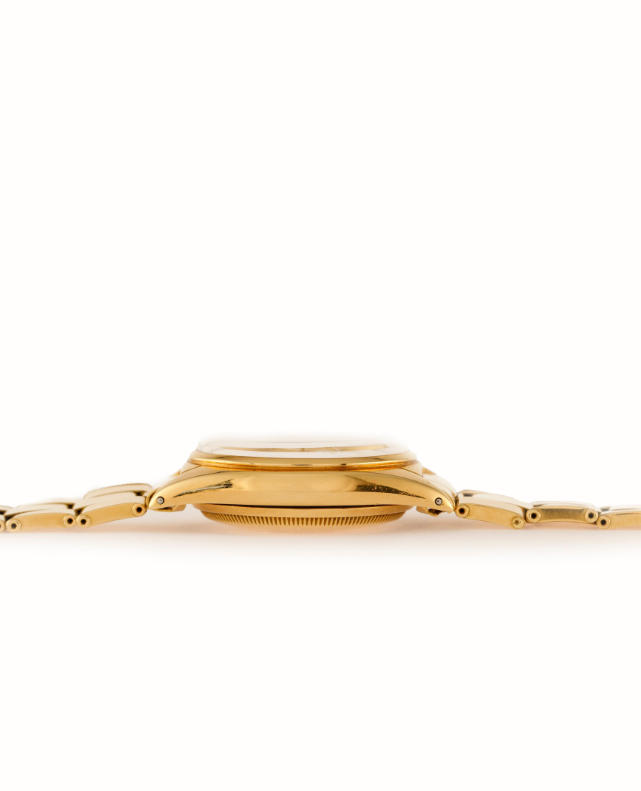
The reason for that shape was largely mechanical. The early automatic movement required more vertical space than later Rolex calibres, so the rear of the case swells outward. What appears fairly conventional from the front suddenly looks much more substantial when the watch is turned sideways.This is one of the most important characteristics of the reference because it changes how the watch sits on the wrist. A diameter of roughly 36mm might lead someone to expect the proportions of a later Datejust 36. In reality, the deeper case gives the Ovettone a different centre of gravity and a much more obviously vintage profile.The Rolex ref 5030 Ovettone case shape matters more than the diameter alone. That point is easy to miss when watches are compared only by numbers.
The case also carries details that belong firmly to its period. The crown is relatively small compared with later Datejust watches, while the bezel has the finer period character seen across early Rolex date watches rather than the stronger, sharply defined fluting associated with many later Datejust references.None of these features looks dramatic on its own. Together, however, they give the watch its identity.
That subtlety is also why early Datejust-inspired replicas can go wrong so easily. A manufacturer can reproduce a cream-coloured dial and old-style hands, but if the case is too flat, the crown too large or the bezel too modern, the watch immediately begins to feel like a contemporary Datejust dressed in vintage clothing.The dial tells the same story in a different way.The date is already positioned at three o’clock, but there is no magnifying lens above it. Rolex did not add the Cyclops to the Datejust until the 1950s, so the clean domed crystal is an important part of the appearance of an early reference such as this one.Without a Cyclops, the date display feels less dominant. The eye notices the dial as a whole rather than being drawn immediately to the enlarged numeral. That may sound like a minor difference, but it changes the balance of the entire face of the watch.
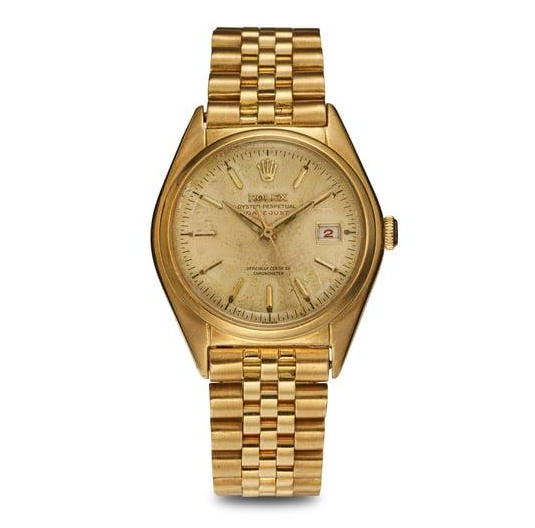
Period examples are generally associated with restrained silver, cream or lightly aged dial tones, applied metal hour markers and slim alpha or leaf-style hands. Some early Rolex date watches from this family can also be found with roulette date wheels, where red and black numerals alternate through the month, although configurations can vary and should always be judged against the individual watch rather than assumed from the reference number alone.This is particularly important with vintage Rolex because surviving watches have often lived complicated lives.
A dial may have aged naturally. A bracelet may have been replaced. A crown may have been changed during servicing. A watch may carry components from a different period after decades of maintenance. A heavily restored example and an untouched example can therefore look surprisingly different even when they began life under the same reference.That uncertainty is part of vintage watch collecting, and it is something replica coverage should acknowledge rather than hide.A vintage Datejust replica inspired by the ref 5030 should reproduce period character rather than exaggerated ageing. A yellowed dial, dark orange lume and scratches added for visual effect do not automatically make a watch historically convincing.Natural ageing is rarely that theatrical.A better interpretation would pay attention to the shape of the hands, the height of the crystal, the position of the date, the proportions of the crown and the relationship between the bezel and the case. These details are quieter, but they are much closer to what gives an original Ovettone its character.
The same approach applies across other early references in our Vintage Datejust articles, where the differences between generations become much clearer when cases, dials and movements are considered together rather than treated as separate specifications.
The Movement Explains Much of What You See Outside
The movement inside the ref. 5030 is commonly identified as Rolex calibre A.295, one of the automatic calibres used during this formative period.For a modern reader, it is tempting to treat the movement as a specification that belongs near the bottom of the article. With an Ovettone, it is more important than that because the movement helps explain the shape of the watch itself.The automatic winding architecture required space. Rolex accommodated that space with the distinctive rounded caseback, creating the silhouette that collectors later associated with the Ovettone name.
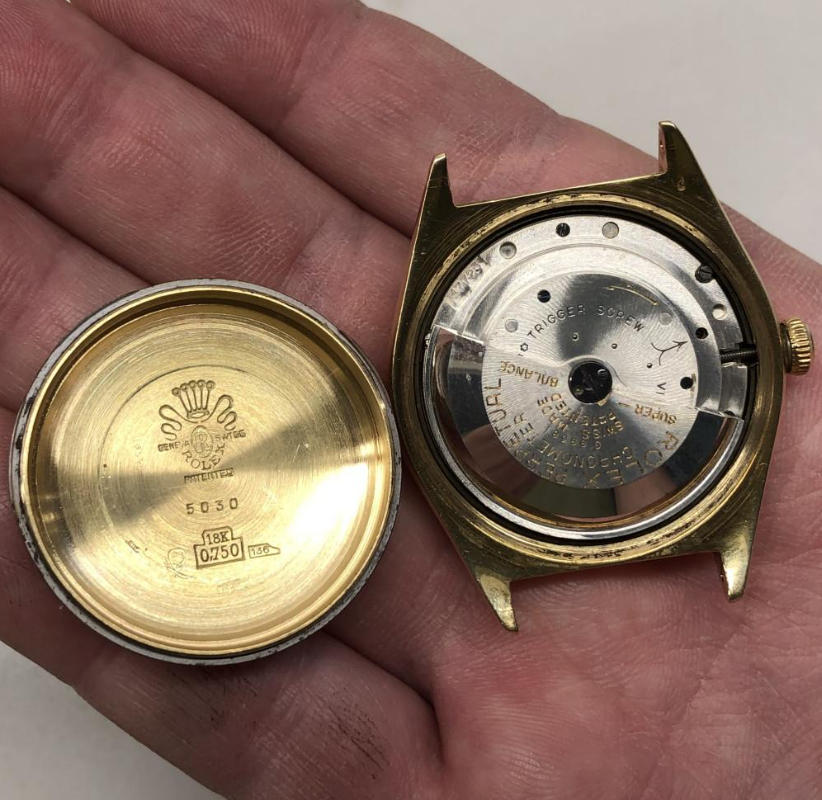
The exterior and movement are therefore directly connected.This matters when judging a vintage-inspired replica because movement decoration is often given more attention than case architecture. A transparent photograph of a clone movement may look impressive, but it tells relatively little about whether the finished watch actually captures the proportions of the original reference.On something inspired by the ref. 5030, I would rather see the correct case depth and rear curvature than an elaborate attempt to imitate every visible bridge of an old movement.The deep rounded caseback is one of the clearest visual signatures of an early Rolex Ovettone. If that feature is missing, much of the point of reproducing this particular reference disappears.The date mechanism also reflects the period. These early watches did not have the instantaneous date change familiar from later Rolex movements. The clean, rapid midnight jump associated with later Datejust generations came only after further development.
Again, this shows how gradually the Datejust became the watch we recognise today. Features that now seem fundamental were introduced over a number of years rather than arriving together in 1945.The bracelet deserves the same historical perspective.Rolex created the Jubilee bracelet for the original Datejust, but early examples should not be expected to feel like a current Jubilee bracelet. Older bracelet construction is lighter, the links tend to articulate differently and the connection between bracelet and case can look less seamless than it does on a modern watch.From a contemporary manufacturing perspective, those differences might look like shortcomings. From a historical perspective, they are part of the reference.
A replica with an unusually thick and rigid modern bracelet may therefore feel more substantial in the hand while being less convincing as an interpretation of an early Datejust.This is a recurring problem in vintage replica watches. Modern manufacturing tends to equate heavier with better, tighter with better and more polished with better. Vintage watches do not always work that way.
The Ref 5030 Is More Interesting When We Stop Trying to Make It Modern
One reason the ref. 5030 is worth revisiting is that it reveals how much of the Datejust identity was still fluid at the end of the 1940s.The Datejust had already introduced the date window that would become one of its defining features. The automatic Oyster architecture was established. The Jubilee concept already existed. But the Cyclops had yet to arrive, movement architecture was still evolving and the familiar dial language had not completely settled.Even the name creates an interesting distinction.
Today, collectors commonly discuss watches such as the ref. 5030 within early Datejust history, but individual dials from this period do not always carry the word Datejust. That makes “pre-Datejust” a useful description in some contexts, not because the watch has nothing to do with the Datejust, but because the collection identity was still becoming standardised.This historical ambiguity should be preserved rather than cleaned up for the sake of a simpler story.It is also why DatejustReplica should not describe the ref. 5030 as though it were simply a 1949 version of the modern Datejust 36. The relationship is more interesting than that. It is an early stage in the same family, but it represents a different way of solving the mechanical and visual problems of an automatic date watch.
There is also a well-known individual ref. 5030 with an unusually rich history. That watch was reportedly purchased by American engineer and inventor Charles F. Kettering and presented to banker Walter H. J. Behm to mark 25 years of service at Winters National Bank. Its engraved caseback preserved the connection between the two men.It is a fascinating story because it reminds us that vintage watches were once simply personal objects. They were retirement gifts, anniversary gifts and daily working watches long before collectors began studying references and dial variations.But that provenance belongs to one watch.It should not be allowed to become the supposed history of every ref. 5030, and it certainly should not be rewritten as though a modern replica carries the same story simply because it copies the same reference.
This distinction is important for a blog focused on Rolex Datejust replica watches. The history of the genuine watch should remain intact. Replica coverage becomes more useful when it asks a different question: what does a modern reproduction actually need to get right if it wants to evoke that original reference?With the ref. 5030, the answer begins with proportion.
The case should have visible depth. The rear profile needs curvature rather than the flatter shape of a contemporary Datejust. The crystal should look appropriate to the period and remain free of a modern Cyclops. The hands and markers need to belong to late-1940s Rolex design rather than being borrowed from a later Datejust. The crown should not overpower the case, and the bracelet should not feel unnecessarily modern.The dial should also resist the temptation to look artificially antique.A convincing vintage replica does not need to look as though it has spent seventy years at the bottom of a drawer. The genuine watches that collectors value most often show age in a much quieter way. Slight tonal change, soft printing and natural variation can be far more believable than dramatic stains and heavily coloured luminous material.
A convincing Rolex Ovettone ref 5030 replica is ultimately a study in proportion, not artificial patina.That is a much more useful standard than calling a watch AAA, perfect or 1:1.Those labels cannot tell the reader whether the caseback is shaped correctly. They cannot explain whether the crown is too large, whether the date display belongs to the period or whether the bracelet has the wrong construction. They reduce a complicated vintage design to a marketing claim.The ref. 5030 deserves better than that because its value lies in precisely the opposite kind of detail.It shows a Datejust lineage before everything became familiar.Its rounded caseback reflects the limitations and ingenuity of an early automatic movement. Its uncluttered crystal predates the Cyclops. Its proportions belong to an era when 36mm was comparatively substantial, yet the watch still feels delicate beside later Rolex designs. Its dial reveals how much the visual language of the Datejust would continue to change during the following decade.
Seen from that perspective, the ref. 5030 is not interesting because it already looked like the Datejust that followed. It is interesting because it shows how much work still remained before that design became established.For collectors, that makes it an important transitional watch. For readers interested in replica Datejust models, it provides an equally useful lesson: reproducing a vintage reference means understanding why the original looks the way it does.Copying the name on the dial is the easy part.Getting the proportions, construction and period character right is where the real work begins.
DatejustReplica is an independent publication covering Rolex Datejust history and replica watches inspired by genuine references. It is not affiliated with, authorised by or endorsed by Rolex SA.
